Explore and share diverse perspectives on our environment!
how we talk about it
how we relate to it
how it is used and managed
Explore the platform
Stories
Maps
Contribute
About the project
User guide
Stories
Maps
Contribute
About the project
User guide
Stories
Maps
Contribute
About the project
User guide
Stories
Maps
Contribute
About the project
User guide
Stories
Maps
Contribute
About the project
User guide
Restoryation Cairngorms seeks to enable a more inclusive and place-based re-storying of Scotland’s biodiversity by collecting and making visible less-heard stories, and highlighting missing stories still to be told.
How to contribute to the Restoryation Cairngorms platform
You may have come across a story or prompt that you would like to respond to. Or you may want to contribute a story that is not related to any of the stories already on the platform. We would welcome contributions in a variety of formats, for example:
Video
Photograph
Illustration
Sound clips (spoken word, song, music and/or other sounds)
Text
Please read the project's ABOUT THE PROJECT page and then request to submit your story. You can do this by firstly accepting the Terms and Conditions and secondly by completing the form which will then be shown. Please ensure that you have the right to use and share the materials included in your contribution, including images, music and maps.
Information on how the James Hutton Institute processes your data is available here.
Please tap the button below to read and agree to the terms and conditions of our hosting your story. After you have accepted the terms a form will be shown that you can complete to make your submission. Please note that the submission form will only become visible after you have given your consent to the terms and conditions. When we have received your submission we will contact you to discuss how we can include your story on the Restoryation platform.
I confirm that I have read, or had read to me, and understand the information about this project (click here for further info). I have had the opportunity to ask questions about the online platform (Restoryation Cairngorms) and related videos by emailing restoryation@hutton.ac.uk.
I understand that my participation is voluntary, and I am free to withdraw my contribution from the online platform at any time (by contacting restoryation@hutton.ac.uk), without providing any reason and without my legal rights being affected.
I understand the project is being conducted by researchers from The James Hutton Institute (JHI) at the request of the Rural and Environment Science and Analytical Services Division of the Scottish Government.
I agree to take part in the provision of a video as part of the project (or in creating a story in a different form such as a photo, audio recording, map, or written text).
I agree that the video or videos (or other form of contribution such as images or written text), in which I may be identifiable, will be uploaded to the project’s Vimeo account, and that this could be used as part of discussion workshops, including with the public.
I agree that clips from the video, in which I may be identifiable, and reflections upon the clips (or other form of contribution such as images or written text), may be used in academic outputs, such as conference presentations or academic journal publications.
I agree to being contacted at a later date in relation to this project and my contribution. I understand that I may opt out of this at any time by emailing Katrina.brown@hutton.ac.uk.
I agree for the views expressed in the video(s) (or other form of contribution such as images or written text) to be analysed and published as reports, academic articles and other publicly-facing publications, and that my words may be quoted. Any quotes will not be attributed to me personally, but may be attributed to my organisation or sector.
I can ask for the views expressed in my video (or other form of contribution) to not be included in the project reporting and publications, up until March 2026 , by contacting the Principal Investigator at Katrina.brown@hutton.ac.uk.
I acknowledge that I have read and understood the privacy notice (please see below).
Privacy notice
The James Hutton Institute (“Hutton”, “we”, “us”, “our”) will collect and use your personal data for the purposes of the research undertaken in this project. Hutton is the data controller in this project. Our legal basis for processing your personal data is that it is necessary for the performance of a task carried out in the public interest in relation to this project funded by the Scottish Government.
On some occasions, we rely on your consent for being able to use your data, i.e. to use in research outputs clips from the video where you may be identifiable. We also rely on your consent for using personal data pertaining to you which under the data protection legislation are considered to be more sensitive and require a greater level of protection. These may be for example information about one’s health, sexual orientation, religious beliefs, race or ethnicity. You have the right to withdraw this consent.
However, the ability to amend the data you have contributed depends on when you make the request. After you have the opportunity to provide feedback on the video and the video is finalised, we may not be able to make further edits and remove parts of or anonymise your data contained therein.
If you wish to request us to delete or stop processing your data or remove your contribution from our project website, please contact: Katrina.brown@hutton.ac.uk.
Your personal data will be stored securely in password protected files in the James Hutton Institute’s servers in the UK. We will publish the project videos, in which you may be identifiable, on the project website. This means that your personal data contained in your video may be accessible outside of the UK. Any other personal data (e.g. raw data, signed consent forms, email communications etc) will not be shared outside the project team at the James Hutton Institute, unless required by law or with your consent and shall only retain it for as long as is necessary to fulfil the project including to deliver project outcomes.
You have rights in relation to your personal data. You can also complain to the Information Commissioner’s Office about our handling of your personal data. Please see our Privacy Notice at https://www.hutton.ac.uk/privacy-notice/ for further information or contact our Data Protection Officer on dpo@hutton.ac.uk.
Please save your choice and then close this window by clicking the 'Submit consent' button below. You must agree to the terms to view the form that allows you to contribute a story.
Please choose to agree or disagree to accept the terms above in order to continue.
Principles to guide the design of the platform and the collation of stories
Principle
Ethical guidelines
Practical implications
INCLUSION
Enabling the inclusion of diversity, especially regarding typically marginalised narratives and related people, ecologies and ways of knowing.
Inviting responses to the content and tags (including contributions and suggestions for contributions/contributors).
Helping contributions happen, including contributions by non-human, and people who don’t have the skills/confidence to make their contributions by themselves.
Active facilitation of absent or marginalised stories, as far as resources allow (e.g. discussing, filming, editing in cases where it may be challenging for contribution to be made otherwise, such as relating to capacities, confidence, time, etc).
Using and engaging inclusive language as far possible (as far as skills and resources allow) and actively suggesting ongoing improvements in how this can become more inclusive.
Where possible, engaging the minority languages of the Scotland, especially as relevant to the case study.
Making present what is not there, and what is not centered.
Flagging gaps, marginalized narratives, people, ecologies and ways of knowing (even where there is currently no content).
Inviting contributions that speak to the relative absences/under-represented.
Inviting suggestions and contributions (including new tags) relating to what is not already flagged.
Preventing marginalized narratives from being buried or hidden.
Making visible things that we may not have the vocabulary for.
Prioritising resources for the collection of most marginalised narratives.
Acknowledging the multiplicity and intersection of axis of marginalization, inclusion and exclusion (e.g., more than one dimension of marginalisation may be significant for any particular person or circumstance, and a particular person may be included or privileged in some ways whilst excluded or marginalised in others).
Tagging stories under different aspects of marginalisation.
When in doubt of whether a story qualifies as marginalized, we include it.
If in doubt, use tags (if e.g. we’re unsure if a story qualifies under a particular tag).
TRANSPARENCY
Making explicit our principles, process, and decisions.
Making our principles, process and decisions visible on the platform.
Inclusion of tags for only those ecologies/habitats mentioned in narratives (e.g. not all that are included in the official list of habitats in the Cairngorms National Park area).
ENCOUNTERING DIFFERENCE/ DIVERSITY
Enabling ‘contact zones’ between tags/narratives, especially those not typically associated or brought together.
Inviting connections and disconnections to be made (between entries or tags).
Facilitating a narrative-led, geographically situated experience of the platform where possible and appropriate.
Linking stories to a location on geographical maps, where possible.
PROVISIONALITY
Acknowledging that people may want to revise their contributions, or they might suggest that contributions are tagged differently.
Taking down stories when contributors ask us to remove them.
REFLEXIVITY
Ongoing reflection on the platform, process and content, to facilitate ongoing learning and co-creation around addressing marginalisation through this project.
Sharing reflections, taking down key learning points, consider submitted suggestions, and make decisions for action points.
Making time to regularly reflect and revise as a team.
CARING
Respect for people’s finite resources.
Use existing sources of narrative (including data collected in previous project, and materials from other projects).
How to explore the video stories
The Stories tab shows videos about different perspectives about the environment. They are organised into three categories: ‘People’, ‘Ways of knowing’ and ‘Ecologies’. Each of the videos suggested under these categories are thematically connected to the video shown on the main pane (although this may not always be obvious). To explore the videos:
Watch the video on the main pane, or if you’re not interested, see step 3.
Scroll through the videos under the themes of ‘People’, ‘Ways of knowing’ and ‘Ecologies’, by clicking on the arrows on either side. If watching on a small device (such as a phone) click on each of these categories, and then scroll through the videos. The videos under these three themes share ideas with the video you just watched on the main pane. Following these can help you explore the interconnected stories on the platform.
Once you find a video you’d like to watch, click ‘Select’. If using a small device, then close the window (X symbol at the top right). This will move this video to the main pane for you to watch.
Click on the map button to see the geographical location of the video (if available). 🗺️
Click on ‘Show more stories’ to get more video suggestions to scroll through under each of the three themes.
Watch as many videos as you feel inspired by – there are around 100 on the platform!
If you would like to scroll through all the videos on the platform, click on ‘Show all videos’, and then scroll through them by clicking on the arrow on either side of the main pane.
How to explore locations on the map
The Maps tab shows the geographical locations of many of the videos. To explore this:
Go to the Maps tab, or click here. The map will appear centred on the last video watched on the Stories tab (if the story refers to a specific location).
The locations of videos are shown as ‘play’ buttons on the map. Click on these to watch the videos and find out more about them. Note that there can be more than one video at a specific location.
Click on ‘Make this the chosen story’ within the popup to make this the video shown on the main pane on the Stories tab.
How to refine what you see on the map
How to change the basemap:
Click on the basemap widget (top right) to change the basemap to an aerial imagery background or other map type.
How to control the map layers:
Click on the layers widget (bottom right). You can turn on historical maps (National Library of Scotland), gendered place names, Forgotten Woodlands place-names, and protected areas (NatureScot).
Click on the eye symbol shown in each of the layers in this widget to turn on and off the layer.
The bar graph symbol on the Ordnance Survey map layers lets you control the level of opacity, so that you can, for example, view the aerial imagery through a partially transparent OS map.
By clicking and dragging on the six-dots symbol on the left of each row you can move the layers up and down the drawing order.
Click on legend button (lower left) to view the symbols used in some of the map layers (story locations, gendered place names, and NatureScot place names).
On the Forgotten Woodland layer, click on a place-name point and then on "Show similar names" to display on the map only placenames with similar woodland types (in English and in Gaelic). To remove the filter click on "Show all names".
How to search for locations on the map:
Use the search button to find specific locations.
Use the buttons on the upper left corner there are buttons to zoom in and out of the map and for setting the map to display full-screen on your device.
Frequently asked questions
How can I find a particular video I want to watch?
To find a particular video you watched earlier, in the Stories tab, click on ‘Show all videos’, and then scroll through them by clicking on the arrow on either side of the main pane, until you find the video you’re looking for.
Can I see a list of all stories on the platform?
The platform currently doesn’t offer a list of stories. However, you can see the full range of stories by clicking on ‘Show all videos’ in the Stories tab, and then scroll through them by clicking on the arrow on either side of the main pane.
How can I find out more information about a video?
To find out more details about a particular video, right click on the video and select ‘View on Vimeo’. This will open a new tab with the video on the Vimeo website, where you can find all the information available about the video.
How can I share a video with somebody else?
Right click on the video and select ‘View on Vimeo’. This will open a new tab with the video on the Vimeo website. Then copy, paste and share the URL for this.
Why do some videos not appear on the map?
Only those videos that refer to a specific geographical location appear on the map.
About the Restoryation Cairngorms project
Restoryation Cairngorms is a research project exploring stories and perspectives about biodiversity that are often overlooked in the Cairngorms. We want to make these voices more visible in biodiversity research, policy, and management.
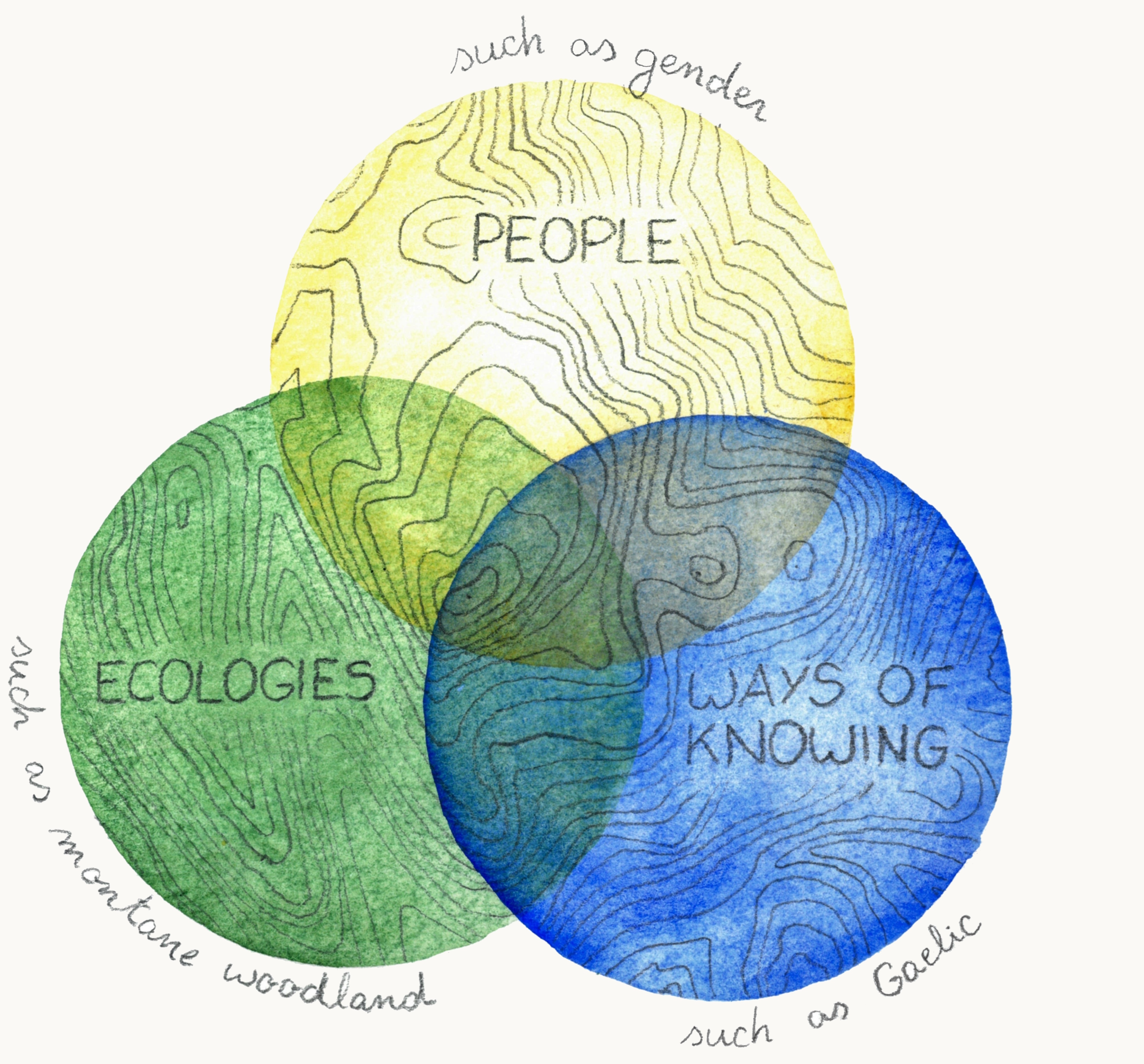
We are interested in stories that are not usually told or heard in the context of biodiversity management and research. These include stories related to:
People
Such as social or cultural groups.
For example related to age, gender, ethnicity, sexual orientation, disability.
Ecologies
Such as species, habitats, biophysical processes.
For example, less visible or charismatic species such as underground microorganisms.
Ways of knowing
Such as experiential, emotional, and sensory as well as scientific ways of knowing.
For example, different languages such as minority, visual, non-human or more-than human languages.
People
Such as social or cultural groups.
For example related to age, gender, ethnicity, disability.
Ecologies
Such as species, habitats, biophysical processes.
For example, less visible or charismatic species.
Ways of knowing
Such as experiential, emotional, and sensory as well as scientific ways of knowing.
People
Marginalised 'people' such as social or cultural groups
Ecologies
Marginalised 'ecologies', such as particular species or habitats
Ways of knowing
Marginalised 'ways of knowing' biodiversity
People
Marginalised 'people' such as social or cultural groups
Ecologies
Marginalised 'ecologies', such as particular species or habitats
Ways of knowing
Marginalised 'ways of knowing' biodiversity
People
Marginalised 'people' such as social or cultural groups
Ecologies
Marginalised 'ecologies', such as particular species or habitats
Ways of knowing
Marginalised 'ways of knowing' biodiversity
The aims of the project are:
To highlight diverse experiences and perspectives about biodiversity in the Cairngorms.
To make space for stories that may be marginalised or overlooked.
To support more inclusive approaches to biodiversity research and management.
Our case study examples
We are currently focussing on three case study examples for re-storying biodiversity:
Gender
The experiences of women and other marginalised genders give us a fuller understanding of biodiversity and its management.
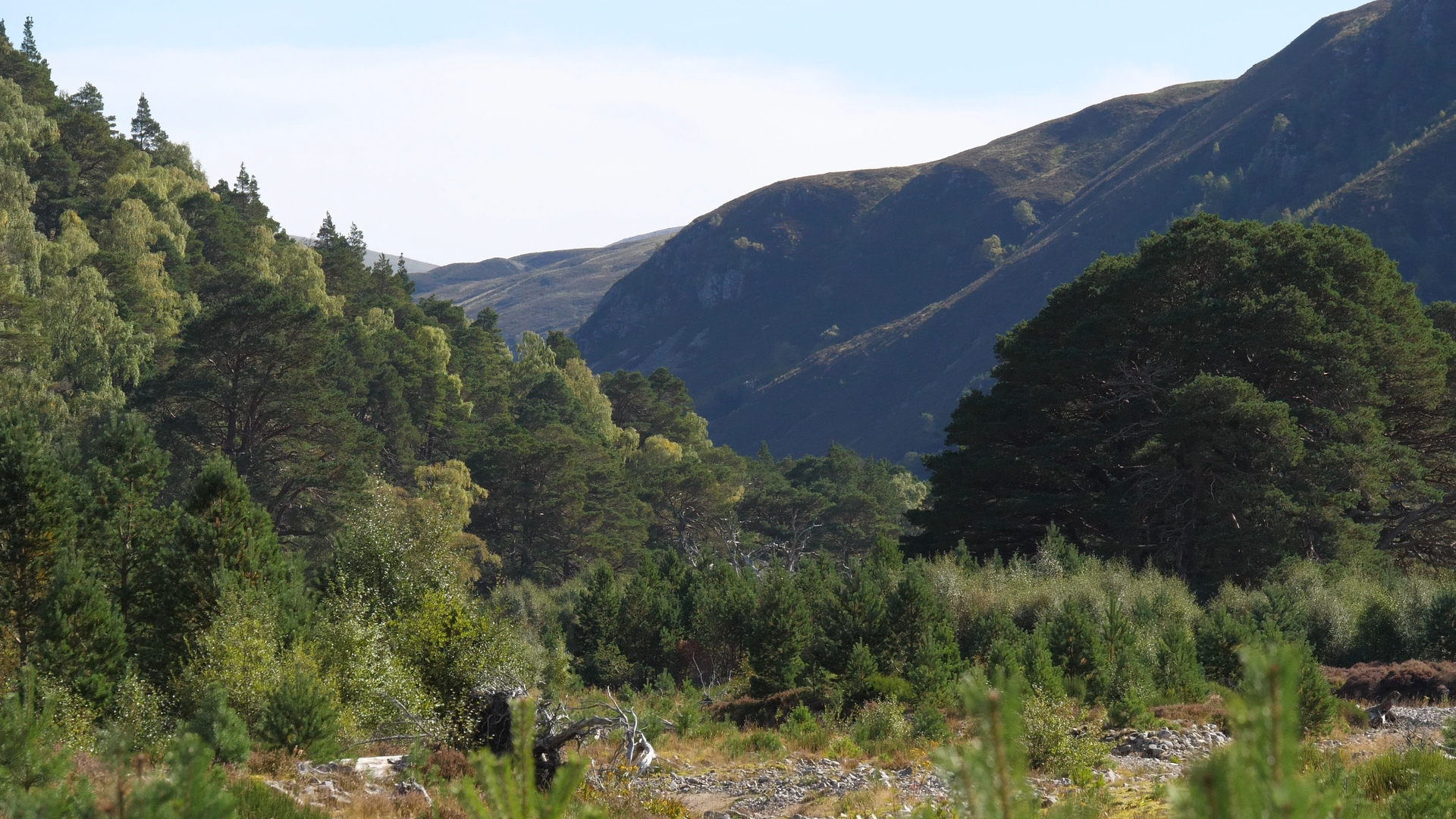
Montane woodland
Understanding existing and potential treeline areas can highlight one of Scotland's 'lost habitats'.
Gaelic
Gaelic language and culture can give us unique insights into nature and biodiversity.
Gender
The experiences of women and other marginalised genders give us a fuller understanding of biodiversity and its management.
Montane woodland
Understanding existing and potential treeline areas can highlight one of Scotland's 'lost habitats'.
Gaelic
Gaelic language and culture can give us unique insights into nature and biodiversity.
Gender
The experiences of women and other marginalised genders give us a fuller understanding of biodiversity.
Montane woodland
Understanding treeline areas can highlight one of Scotland's 'lost habitats'.
Gaelic
Gaelic language and culture can give us unique insights into nature and biodiversity.
Gender
Experiences of marginalised genders improves understanding
Montane woodland
Understanding treeline areas can highlight 'lost habitats'.
Gaelic
Gaelic language and culture can give us unique insights
Gender
Experiences of marginalised genders improves understanding
Montane woodland
Understanding treeline areas can highlight 'lost habitats'.
Gaelic
Gaelic language and culture can give us unique insights
Why stories?
Stories help us make sense of the world and ourselves. They shape how we talk about and act on our environment and biodiversity. The stories that dominate discussion, policy and research can influence which problems are recognised and prioritised, and what actions and decisions are taken, including who gets included and who gets left out, what we value, and what we choose to protect. By paying attention to narratives, we can spot gaps, assumptions and biases and help biodiversity work become more effective, inclusive, and better grounded in lived experiences.
By showcasing these stories on this platform and tagging them under the three themes (People, Ways of Knowing, and Ecologies), and under specific topics such as gender, Gaelic, and montane woodland, we hope to enable people to encounter stories they are interested in and familiar with, as well as stories they are less familiar with.
How to contribute
We invite anyone with a story or perspective related to biodiversity in the Cairngorms to contribute. We are not just interested in people with specialised knowledge, but also knowledge that comes in wider range of forms including emotional, artistic, and experiential.
Please send us your video in a finalised form, preferably filmed in landscape/horizontally-framed. You may want to record in a place or with objects, species, or practices that matter to your story. You can find full instructions on the CONTRIBUTE page.
You can also send us a story in a different form, for example, a written text, audio recording or an image.
Or, if you feel that certain stories, places, or perspectives are missing, please email us at restoryation@hutton.ac.uk. You can also encourage others to get in touch if they might want to share their own experiences.
How your story will be used
With your consent, your contribution will appear on this platform under the categories of People, Ways of Knowing and Ecologies, and tagged with specific topics such as gender, montane woodland, and Gaelic. This will enable people to encounter stories they are interested in and familiar with, as well as stories they are less familiar with.
We plan to keep the website live in perpetuity, to allow for continuous learning and discussion about biodiversity narratives. However, if you would like us to take down your contribution, you can email us at any time at restoryation@hutton.ac.uk or by contacting the Principal Investigator Katrina Brown
We may also use the stories and the platform as a tool in discussion or decision-making settings such as workshops.
Your contribution may also inform research outputs such as reports, conference presentations or academic journal publications. These may mention that one or more people from your sector or organisation participated in the research, but individual names will not be used.
Ethics and consent
The project has been reviewed by the Research Ethics Committee of the James Hutton Institute.
We do not anticipate any personal risks of taking part in this research. You may wish to discuss personal information in your video (or other form of contribution such as images or written text), for example, related to your gender identification, ethnicity or sexual orientation. However, the content of your video is entirely up to you, and you can ask us to withdraw it altogether from the platform at any time. If addressing this type of personal information in your contribution, we may ask you if you would be happy to have the video organised under a certain category, for example, ‘ethnicity’, ‘gender’, or ‘sexual orientation’. This would help your story to be suggested to other people exploring the platform.
In this project we follow a set of principles to guide the design of the platform and the collation of stories. These are: inclusion, transparency, encountering difference/diversity, provisionally, reflexivity, and caring. Click here to see more details about these principles and how we put these in practice in the project.
What are the benefits of taking part?
While there may be no immediate benefits for those people participating in the project, it is hoped that this research will lead to greater understanding and inclusion in relation to biodiversity research and management, including amongst land managers, policy and other decision makers.
Funding and acknowledgments
The project is funded by RESAS (Rural and Environment Science and Analytical Services Division of the Scottish Government).
We are grateful to everyone who has contributed to this project - by sharing their stories, creating content, or supporting the work in other ways. In future, with permission, we will list contributors by name on this website. The stories represent the contributors' perspectives, not those of the James Hutton Institute, the Scottish Government, or RESAS.
Further Information
For further project details, please visit the project website or contact the research team:
Katrina Brown
The James Hutton Institute
Aberdeen
AB15 8QH Katrina Brown
Tel.: 07815732765
Alba Juarez Bourke
The James Hutton Institute
Aberdeen
AB15 8QH Alba Juarez Bourke
Tel.: 07522110361
Cairngorms National Park
The stories
×
People
Ecologies
Ways of knowing
For more stories, browse through the boxes below
on the themes of...
People
For example, gender
Type 1
Inspired by November colours
Ecologies
For example, montaine woodland
>
Type 2
Trees and placelessness in the green economy
Ways of knowing
For example, Gaelic
Type 3
Land is our community
Mini-map of location
Location of your selected video
Menu to choose a video
You can select videos matching all of the items you check below or matching one or more of the items you select.
Tick boxes in the rows below to select videos matching the categories.
People
Ecologies
Ways of knowing
This view can be dismissed by clicking the button below.